
Narrative Signal Profile
At a Glance
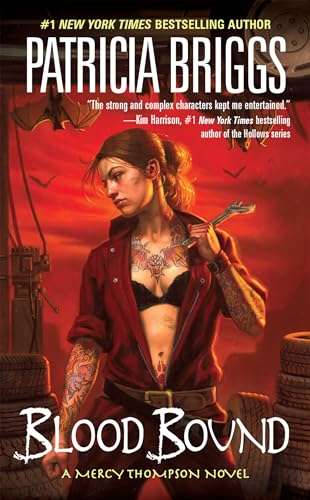
Blood Bound by Patricia Briggs is a dark, suspenseful urban fantasy novel set in the Tri-Cities of Washington, where mechanic and coyote shapeshifter Mercy Thompson moves through a hidden landscape of vampires, werewolves, and fae. The story follows Mercy as she’s pulled into a dangerous bargain with the local vampire seethe to confront a demon-ridden vampire whose rampage threatens both supernatural and human communities. The Columbia Basin Pack and the vampire Mistress’s territory act as concrete centers of power, with favors owed and territorial rules shaping every encounter. From the beginning, the plot is clearly driven by supernatural politics and the dangerous weight of power and its implications, forcing Mercy to test her loyalty and accept that personal desires vs. responsibilities rarely line up cleanly in this world.
Comparative Context
The core mechanisms in Blood Bound are strongly rooted in supernatural politics, territorial power structures, and the informal economy of favors. The Tri-Cities are carved up between the Columbia Basin Pack, the vampire seethe, and other hidden beings, each enforcing strict rules about territory, secrecy, and who is allowed to act. Mercy’s status as a walker places her outside these formal hierarchies, yet her close ties to Alpha werewolf Adam and vampire Stefan keep drawing her into conflicts she would rather avoid. The demon-ridden vampire is not only a terrifying monster but also a political crisis, because its violence risks exposing the supernatural world and destabilizing existing truces. The seethe’s rigid hierarchy pressures Mercy to comply, while the pack’s protective instincts complicate every decision. The vampire seethe’s demand for obedience drives Mercy’s struggle with personal desires vs. responsibilities, because every favor she grants or refuses reshapes her safety, her relationships, and the moral ambiguity she has to live with.
Reader Fit
Best suited for readers looking for dark urban fantasy where emotional intensity, power and its implications, and loyalty under pressure are a defining part of the experience, and where character immersion in Mercy Thompson’s perspective matters as much as the supernatural threat. The ideal reading mood is one where you’re ready to sit with moral ambiguity and with personal desires vs. responsibilities pulling a protagonist in conflicting directions. Less suited for readers wanting lighthearted escapism, rapid-fire plotting, or neatly resolved ethics without lingering gray areas. A friction point: the emphasis on supernatural politics, favors, and consequences can make the story feel heavy and keep the suspense simmering rather than constantly explosive. The reward: a strongly character-focused narrative where loyalty has real costs, and every choice Mercy makes within the Columbia Basin Pack and vampire seethe feels consequential.
Within urban fantasy, what separates Blood Bound from many similar novels is that its central conflict clearly depends on supernatural politics and the personal cost of loyalty rather than on nonstop action or flashy magic. The demon-ridden vampire is frightening, but the real pressure comes from how the vampire seethe, the Columbia Basin Pack, and Mercy’s outsider status intertwine to expose power and its implications in concrete, often uncomfortable ways. Instead of leaning primarily on quips or romance to offset the darkness, the book keeps its tone strongly dark and lets moral ambiguity stay close to the surface. That focus on personal desires vs. responsibilities, filtered through Mercy’s relationships and obligations, gives the story a notably emotional core that stands out in the category.
If this book resonates with you
Books that explore similar ideas and reading experiences.

Readers drawn to this book often connect with stories that explore identity and loyalty.
- Identity
- Loyalty
- Power dynamics
What this book shares
- Explores similar thematic territory through multiple overlapping elements.
- Focuses on meaning over narrative momentum.
Trade-offs
- May have a different pacing or structural approach.
Why this appears here
- Shares core themes with the current book.
- Explores similar reflective and introspective ideas.
- Often appreciated by readers drawn to quiet fiction.

Readers drawn to this book often connect with stories that explore duality of human nature and fragility of innocence.
- Duality of human nature
- Fragility of innocence
- Moral ambiguity
What this book shares
- Explores similar thematic territory through multiple overlapping elements.
- Focuses on meaning over narrative momentum.
Trade-offs
- May have a different pacing or structural approach.
Why this appears here
- Shares core themes with the current book.
- Explores similar reflective and introspective ideas.
- Often appreciated by readers drawn to quiet fiction.

Readers drawn to this book often connect with stories that explore loyalty and deception.
- Loyalty
- Deception
- Moral ambiguity
What this book shares
- Explores similar thematic territory through multiple overlapping elements.
- Focuses on meaning over narrative momentum.
Trade-offs
- May have a different pacing or structural approach.
Why this appears here
- Shares core themes with the current book.
- Explores similar reflective and introspective ideas.
- Often appreciated by readers drawn to quiet fiction.
Continue the Reading Path
You've seen the obvious matches. Explore the full ranked map — organized by signals, not just genre.
Your place in this book
Read quietly — or leave something behind.
Community Content
(0)No community content yet for this book.
Be the first to create a meme or share your thoughts!
Interpretive Commentary
Reading Blood Bound feels clearly dark and often tense, with pacing that is notably suspenseful rather than relentlessly fast. Scenes of confrontation, investigation, and supernatural threat tighten the narrative, while quieter stretches give space for the emotional cost of choices to register. Cognitive load sits at a moderate level: the rules of the Columbia Basin Pack, the vampire seethe, and the broader supernatural community are straightforward to follow, but the shifting debts, alliances, and power and its implications require attention. The emotional tone is strongly intense, as Mercy’s loyalty is tested and personal desires vs. responsibilities collide under real danger. Narrative distance stays close to Mercy, keeping the focus meaningfully character-centered and allowing readers to inhabit her reactions to fear, obligation, and moral ambiguity. Plot momentum feels steady, prioritizing character immersion and the weight of consequences over constant spectacle.